Showing posts with label Firepit. Show all posts

Monday, May 18, 2015

- Worth waiting for: On the banks of Sink Creek

Looking upstream

In the nearly five years that we have lived on our homestead I have never seen Sink Creek. Oh, there was evidence of its existence on the aptly named flood plain, but whenever there was a gully washer I was either at work or it was the middle of the night or there was too much thunder and lightning to safely go outside.

Until yesterday, when the storm clouds dumped 3.5 inches of rain in a  few hours, making a river out of our front yard ...


then quickly pushing off to the east, enabling me to finally take a look before the water soaked into the aquifers below. 

Our fire pit, which has stood unused through the recent years of drought, became a nascent mosquito pool ...


So I undammed one end to let the water drain out ...


Slogging through the recently mulched West Trail lichen farm, we were glad to see that our efforts were worthwhile as the water pooled under the branches without breaking through and washing out the path as it had in the past ...


But it was the flood plain that inspired the most excitement. Water was moving, rapidly ...

The creek already receding ... sinking into the earth

and up to a foot deep, carrying with it seeds and silt, Mother Nature's best planting method ...


Indeed, last year's heavy rains carried bluebonnet seeds from upstream where they bloomed for the first time on our property earlier this spring ...


With this most recent deluge, I have no doubt new seeds have been spread even farther downstream.

But it was the voice of the water, chuckling through the rocks, that most delighted me (if only I could figure out how to insert a video into Blogger, you could hear it, too). Instead, I'll just leave you with one last look from the headwaters of Sink Creek ...

Looking downstream

already gone, but not forgotten.

Friday, March 13, 2015

- It's springtime in Texas, so of course the leaves are falling

Here in the Texas Hill Country we get "fall" in the spring.  The live oaks are currently in the process of shedding the leaves they held on to all winter. It's a great system: the new leaves push the old leaves off and grow in their place. So these trees will bare their branches over the next couple of weeks and then be covered in completely new foliage shortly thereafter ...


Consequently, leaves are everywhere, blown off by the March wind and rain that roared through earlier this week ...


Likewise, much of the ash from the deadwood and brush that we burned last weekend has blown and/or washed away, leaving the burn pit empty, awaiting the next installment ...


Fortunately, before the rain fell I was able to shovel some of the ash onto the inner wall of the burn pit ...


where it now serves as a kind of mortar for another layer of stone ...


And this is the windfall lichen that was spared from the flame, a patch about 6' wide and 12' feet long ...


bound for the lichen farm along the west trail ...


Last, but not least, here's a shot of Don using my wheelbarrow alternative, a 2' x 3' cement mixing tub with rope attached so it can be pulled over rocky ground and wood chip trails alike ...


and an odd bit of wood found along the way ...


Who knows what Don will find to do with it ...

Friday, December 19, 2014

- The yin and yang of gardening: A tale of the planter and the pruner

The blog posts about brush whacking and grass growing in the Hill Country were written from the admittedly biased viewpoint of yours truly. I should add that my family nickname is "The Mad Pruner" and this is but one of my recent efforts, soon to be chipped into mulch by our faithful arborists ...


Don, on the other hand, is the creator of our many rock gardens. 

He's been able to transplant reportedly tetchy natives like mealy blue sage and Zexmenia from the floodplain, and the plants he purchases from local nurseries absolutely thrive ...


Also under his watch, the Mexican feather and buffalo grasses have spread, while numerous Agaves and Spanish daggers have been artfully relocated ...


My forte, on the other hand, is building compost heaps from assiduous cactus whacking efforts ...


and I'm definitely better at hauling rocks and dumping them around the perimeter of the burn pile than placing them artfully into useful plant beds. Fortunately, we both love a good fire, so when the weather is right, we're always ready ...


And somehow in the end, between the adding and the taking away, things seem to take root and grow ...

Stewards we aspire to be, Tweedledum and Tweedledee.

Wednesday, November 26, 2014

- A river ran through it: Scenes from a gully-washer


Even though we live in drought much of the time, every year or so we get enough rain that our homestead becomes waterfront property. Of course, by the time the thunderstorms pass through and we get out to the flood plain, there's not much left of it ...


We were fortunate this time around that we didn't get 7 inches, as we did during the Halloween 2013 flooding. Even so, 4.3 inches of rain is enough to fill a copper dye pot ...


freshen up the windfall lichens ... 


beat down the "bad grasses" and leave the little bluestem standing tall ...


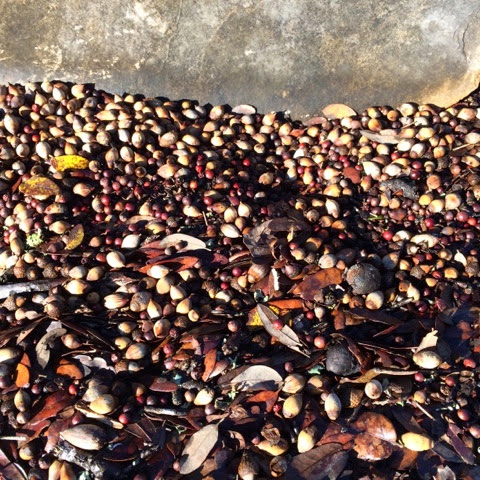
wash all the acorns down the driveway ...

where they can be gathered along with the oak galls ...

and douse the burn pit, readying it for another day ...

There's so much promise in the land, just waiting for the seeds to fall ...

Thursday, November 20, 2014

- Back stories: Cloth and stone projects come together

The woven cloth base for the pillow is finally stitched together and ready for the embellishment phase. I decided to hang it in the window for this picture, which clearly shows where I did and did not get the cloth strips close together ...


Live and learn ... next time I will try working smaller pieces of woven cloth and then join them together into a larger piece. Of course, that's what Jude Hill  suggests in Cloth to Cloth, but there's nothing like doing it "wrong" to learn it "right."

I also discovered that the running stitch was not nearly as effective as backstitch in stabilizing the cloth ...

Close-up detail of back ...
note that I'm not too concerned about cutting off thread ends
which I realized about a quarter of the way through ...

The lower quarter worked in running stitch,
the upper three-quarters worked in back stitch

I also found myself more comfortable doing back stitch, which you can see here was discontinuous, so it actually resembles a running stitch ...

The square shown here is about 2" to a side ...
the stitches are worked with 2 strands of floss, not necessarily the same color

Next up: I have some "opportunities" in the form of those gaps between some of the cloth strips ... it will be interesting to see how stabilizing them becomes part of the cloth's story.

However, now that it's cooler we are in prime landscaping season (which hopefully means we're somewhat less apt to encounter snakes ... or that they'll move a bit slower if we do). So there will be more time spent outside cutting scrubby brush (acacia, Yaupon, persimmon, and agarita) and whacking prickly pear cactus to encourage growth of our prairie grasses (little bluestem, yellow indiangrass, side-oats grama, and buffalo grass, among others).

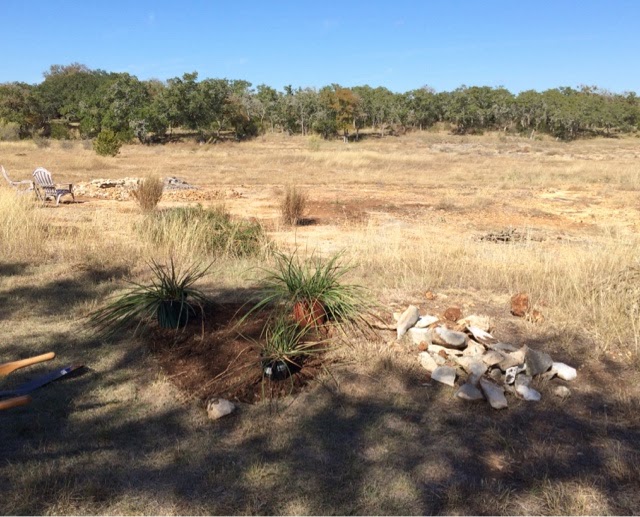
Don has also started another rock garden bed out back by the burn pit ...


using home-grown compost and some decomposed granite (from the walkway project) to enrich the clay soil ... limestone and chert nodules "harvested" from the side yard ... red yuccas rescued from a nearby neighborhood garden renovation ... and leftover landscape cloth. Which means the total project will require no current out-of-pocket expenditure ... just a little (ha) effort to get everything together ...


And while Don places each stone by hand, I'm working on covering the ugly composite concrete in the burn pit (see yesterday's post) with bucket-loads of floodplain stones. Final pictures pending ...

Tuesday, November 18, 2014

- Scent-sational: Clean sheets and wood smoke

There's been some talk over at Grace's Windthread about the joy of air-dried sheets ... to which I would add the scent of wood smoke on a cold clear day ...


This was a fairly modest burn pile, only 6-8' in diameter and about 3' high. We got through all the accumulated  dead wood and brush in only three hours, compared to our last burn which was an all-day affair.

Since we don't have water piped out to the flood plain, we damped down the fire with cactus pads ...


 and having finished so quickly, we've already started piling up more brush for the the next time.

Saturday, October 4, 2014

- Compost (like Grace) Happens

It's amazing how my attitudes have changed over the past five years ... from "Five acres? No way!" to "Well okay, but I'm only going in the high grass when it's cold enough for the snakes to be hibernating" to cactus whacking all summer long (albeit in full-length pants, socks and shoes).

What with all the leaves and garden debris, we've had three compost piles for a while now:


In fact, the first one has been emptied and restarted a couple of times. The second one is also our kitchen compost (aka critter feeding station) which is a favorite with the deer, the turkeys, and nighttime visitors (skunk, armadillo, and raccoon are all possible candidates). The night visitors are especially helpful as they like to dig through the pile (for grubs?), which turns everything over. The third pile is on its second go-round and has a long way to go.

But as we began clearing prickly pear cactus in earnest, we realized we needed more compost piles, so we moved out to an open area by the flood plain, creating the fourth pile, currently capped with grass and leaves from this spring ... so we won't peek for another six months. I know you're supposed to turn compost, but if you wait long enough, compost happens.


Then things got a little crazy ... I started two more piles and ended up falling into one of them whilst trying to dump a load of prickly pear (see my May 29 post "On pins and needles"). That was when I realized I needed to go out rather than up and our compost piles became compost rows ... four of them at present, each ranging from 15 to 25 feet long.


I'm in the process of putting a layer of "bad" grasses over the cactus ... except for the last row, which I'll leave exposed.


That way when we burn brush and tree limbs out on the flood plain, the cactus pads can be used to cover up the embers when we're done. Since they're full of water, they pretty much put the fire out. Amazingly, some of the cactus actually survives and begins to sprout ... forming a great fire break (or is that "brake") for the next burn.

But before we burn again, I have some harvesting to do ...


because those little white spots are making me see red ... yep, cochineal red.

To be continued ...