Showing posts with label TRIANGULATION. Show all posts

Wednesday, May 13, 2015

- Triangulation: The last word

Jude Hill has been talking about measuring in her Small Journeys on Spirit Cloth ... or more accurately, about not measuring. About trusting the process and one's own internal measure.

Which makes sense. When you think about it, we're all pretty good at measure. Think of tipping your head while looking at a picture on the wall and saying, "That's not quite level" ... then confirming it with a level, as if you really needed it.

For years I have reveled in clean-the-fridge cooking, where there always seems to be the right amount needed for a pasta or a salad, a soup or a sandwich. I made bread at my daughter's recently and there was just enough bread flour in the bag for what I needed. I love it when that happens.

But it takes practice to trust one's gut, to accept the unexpected, to internalize the measure of things.

And so ... Triangulation was a huge leap of faith for me. Made without measuring, without a plan ... strips of cloth torn and woven together ... then stitched and stitched and stitched again until its integrity was sure in my hand ... then wrapped around a piece of stuffing that had been free-cut from an old body-length pillow months before ... finally safety pinned and ladder stitched together.

Resting at last on the couch, a-side ...


or b-side, depending on how it falls ...


The top seam more obvious ...


the back seam less so (it's the second from the right) ...


There is much to be said for not measuring.

Tuesday, May 5, 2015

- The passage of time

As James Taylor says, "the secret of life is enjoying the passage of time" ... whether it's flying by when spending it with loved ones or dragging by when you're waiting for news or a special day.

So my solution to waiting for the latest dye trial results was to go out of town. It was worth it in every way imaginable ...


Of course, the best part of waiting was visiting the grands in Missouri ...


Followed by coming back to our Texas grandson ...


But getting to the dye results was definitely a little less sweet. I hadn't capped the jars tightly enough, so leakage and mold happened over the course of ten days ...


Rinsing off the decomposed plant matter was akin to what I imagine a dental hygienist experiences on a really bad day. Definitely not for the weak of stomach! But the results were pretty cool, some more so than others of course (this photo was taken following a preliminary rinse in warm tap water) ...


Mordants from left to right (note: all the cloth was pre-mordanted in soy milk, kept overnight in the fridge then rinsed):
  • Copper
  • Alum
  • Iron
Dyestuffs from top to bottom:
  • Lichen (windfall Parmotrema austrosinense)
  • Mealy blue sage (wild Salvia farinacea)
  • Rosemary (Rosmarinus officinalis)
  • Salvia amistad and S. greggi
  • Red cabbage
  • Red and yellow onion skins
My favorite? The alum mordanted Salvia amistad ...


Oh, and I almost forgot! Here's the B-side of Triangulation, now fully reinforced and worth every extra stitch, although the front looks virtually the same as before (which is why I haven't shown the A-side here) ...


The final reveal will probably be in pillow form, but only time will tell.

Thursday, April 23, 2015

- Dyeing to peek

Well, I'm trying dyeing again, inspired by India Flint's Bundle Book (which I bought in digital form) ...


this time using 14" squares of unbleached cotton muslin soaked in store-bought soy milk (I blush), dried overnight, rinsed and spun through the washer until  just damp.

I laid various dyestuffs (listed below) across the middle of each muslin square ...


folded over one-third of the muslin and laid out a second layer of material ...


folded it over yet again ..


rolled snugly ...


then wrapped each bundle in cotton or wire (detailed below) ...


The dyestuffs I'm using this time are fresh rosemary (shown above), dried red and yellow onion skins (combined), chopped red cabbage, windfall lichen (Parmotrema austrosinense), mealy blue sage (wild Salvia farinacea) ...


and a combination of cultivated Salvia amistad and S. greggi from Don's garden beds ... 


I made three packets of each dyestuff, then wrapped them in either copper wire, steel wire or crochet cotton. 

The copper wire bundles went into a copper pot with untreated well water from our outdoor tap. The smell of sulfur from our 900' well is unbelievable and I'm hoping there will be a chemical reaction with the copper. After simmering the bundles for just over an hour some blue is starting to show ...


After a couple of hours, I'll put the copper bundles and the sulfur-rich steeping water into canning jars with used tea bags and seal them up.

The steel wire wrapped bundles have already been put into canning jars with boiling tap water, used tea bags and fine steel wool. However, after one hour the color got so dark (see below right) that I chickened out and removed the steel wool (leaving a small bit behind, no doubt).

Finally, the cotton wrapped bundles were put into a solution of boiling tap water and pickling alum (1 tsp. per canning jar) along with the obligatory tea bags, which are also starting to show color (below left) ...


Now the question is, can I keep my hands off of the dye trials for at least a week?

Fortunately, I have a plan. Having finished the kantha stitching on Triangulation ...


I'm now "design mending" (a Jude Hill term) by invisibly basting strips of cloth onto the back along the intersections since the original cloth weaving strips don't meet closely enough ...

I started design mending with dyed sheeting, then decided to switch over to muslin for the remainder

It's gonna take a while ...

The bottom shows a 1" strip of muslin invisibly basted across the length of the cloth
which will be the method used for the remainder of the design mending

But my reward for finishing will be the dye trial reveal. Motivation times two!

Sunday, April 19, 2015

- Remembering to keep things in perspective: A matter of scale

Triangulation has passed the three-quarter mark, so I'm now squarely in the southwest ...


I belatedly realized that a scale might be useful. As near as I can figure, Triangulation comes in at 50 miles to the inch ...


making the entire cloth 1800 miles wide by 1100 miles high ... which sounds way more impressive than 36 inches by 22 inches.

It's all a matter of perspective, which has been much on my mind since today is the anniversary of my mother-in-law's passing on April 19, 2010.

I may have learned "Food is love" from my mom, but I learned how to be a grandmother from Betty May Angus Ackert, who practiced love unconditionally.  Her granddaughters were the brightest, most beautiful children on the planet and absolutely without fault in her eyes.

They loved her absolutely in return. And what child wouldn't love having a sleepover room, a kitchen window that doubled as a fast-food drive-in, a lovable golden retriever to snuggle, and visits to the dollar store for fashionable jewelry ...


I could always tell when the girls were on the phone with Grandma, who knew how to ask open-ended questions that triggered an animated retelling of whatever was uppermost on their minds. They knew she hung on their every word and the proof of their shared love was clear to see, even in their teenage eyes ...


I hope I can live up to her example ...

Monday, April 6, 2015

- Way finding: Triangulation continues

Triangulation definitely needed a compass rose and I also wanted to put a sun symbol over New Mexico. In the end, I melded the two notions into one ...


Sketched in permanent ink, it wasn't perfect, but I'm getting better at accepting that. 

So now that I've reached New Mexico, I'm pondering whether or not to use the Desert Sand DMC floss I picked out ...


Finally, having passed the half-way mark in Kantha stitching, I decided to try draping the cloth, which is really too large for a flat-on-the-floor shot ...


To be continued ...

Sunday, March 29, 2015

- Of books and backs

Anne Lamott and Anna Quindlen are two of my all-time favorite authors (see links in the OTHER ARTISTS AND AUTHORS sidebar to the right). So, when I read a library copy of Anne Lamott's Stitches, I thought it would be cool to get my own copy and stitch the best passages, rather than underline them as I usually do. Initially unable to find a copy readily available, I decided to apply the same idea to Anna Quindlen's Lots of Candles, Plenty of Cake ...


It's been interesting trying out backstitch ...


and double running stitch ...


versus plain running stitch ...


But honestly, at this point I'm not quite sure how I feel about it ... so I'm letting the idea compost for a while.

Meanwhile, I'm still plugging away on Triangulation (65 squares stitched, 95 to go). Taking a cue from Grace, I hung it in a window (which was only partially sunlit) and took some pictures of the back (so east is to the left and west is to the right) ...


Here's the B-side of the arch in St Louis, where the only thing holding the cloth strips together is running stitch and some embellishing stitches ...


This view shows intersecting horizontal and vertical running stitches - an attempt to better fill the gaps in the cloth weaving ...

Tulsa, Oklahoma at the intersection of I-44 and I-75

And this view shows how much more substantial the back stitch proved to be in stabilizing the cloth weaving (fortunately, I figured that out about a quarter of the way into the initial stitching) ...

The flip side of southbound 35, Austin and San Marcos


As I've mentioned before, never will I ever again cloth-weave sheeting and back it with Harem cloth. Besides which, what was I thinking tackling a piece this size to begin with? But I must say continues to be an interesting exercise in problem solving.

Postscript: Southbound 35 is what I slip in the CD player when we cross the Red River from Oklahoma into Texas ...


Tuesday, March 24, 2015

- Learning the hard way (as usual): The sheeting challenge

I looked back to check, and yes ... there in the very first comment of the very first post on Triangulation was this warning from Beth at Still Life Pond: "Sheeting can be difficult to hand stitch."

But did I listen? No! 

She was right of course and I have learned by doing that sheeting is a challenging cloth indeed. My needle test did not take into account the doubling effect of cloth weaving. Nor did my running stitch predict the challenge sheeting would pose to a fine back stitch.


Still, I'm too far in to give up now.

By the way, I somehow miscounted the squares (which are 1 1/2 to 2 inches to a side). There are 16 rows of 10, not 17 rows of 11. So, having now stitched 40 squares, I'm one quarter of the way through ...


Thursday, March 19, 2015

- Christmas season continues: A return to Triangulation

Someone posted recently about gift giving (forgive me, I can't recall who it was). The gist of it was that gifts given spontaneously, especially upon completion of a handmade piece, can be much more satisfying than gifts given on calendar-driven deadlines.

Having already embraced the concept of "Birthday Season" it was a fairly short leap to "Christmas Season" ... which is what I am now calling the period of time it takes to complete all the gifts I intended to give last Christmas.

In fact, I only managed to get one handmade Christmas gift given on time: the kitchen towel All Roads Lead to the Beach. But I gave myself a pass on the Close Your Eyes books since my grandsons are still too young to mind the lapse.

So now that I have finished the books for Jace and Griffin, I am returning to a belated gift for Don: Triangulation ...


I'm actually glad I took a break from it since I learned a lot in the process of making the other pieces and in following other blogs. For instance, there is Grace's current project wherein she is intentionally stitching folds into cloth. This released me from the angst I experienced when I realized my insufficient invisible basting had led to excess folds of cloth in Triangulation. Now I'm embracing the folds, happily incorporating them ...


I also discovered during Close Your Eyes 2 that I prefer a single strand of floss to two in many cases. As a result, I am enjoying the rhythmic repetition of single-thread Kantha stitch combined with the mantra "om mani padme hum" (another gift from Grace ...but for those of you who have observed my spiritual pursuits in the past, this doesn't necessarily mean I'm embracing Buddhism) ...


And because my alternating horizontal and vertical blocks of Kantha were inspired in part by Saskia over at the Birdhut, I would be remiss if I didn't include a picture of the B-side for her ...


So settle in folks, I've got 13 squares down and 174 to go. It's gonna be a long Christmas season for sure.

Monday, November 24, 2014

- Being brave: Lettering with a Pitt pen

I have never been satisfied with my handwriting ... scrawl really. And so at first I tried using rubber stamps to letter my work, but the size was too fixed, the letters too regular.

Then I tried  writing in my own hand using water erasable markers, but the lines were so heavy that it wasn't much fun.

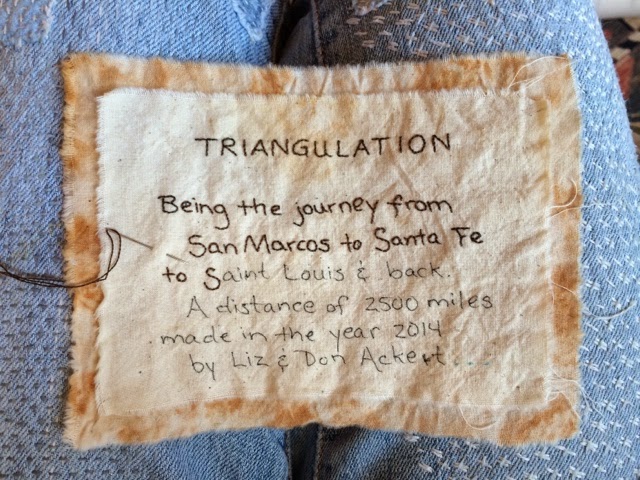
So this time I decided to use the permanent ink Pitt pen ... worried that I would make a mistake halfway through and ruin a piece of cloth ... deciding to use a scrap of rust-dyed cotton muslin that hadn't taken a strong image of Don's wonky metal thing ... I could always try again.

The point of the Pitt pen was so fine it surprised me when it didn't catch on the cloth. I lettered TRIANGULATION with such care ... holding my breath.

Then stopped and wrote out the rest of the words on paper, just to see. And it looked okay, so I wrote them on the cloth. Faster at first, until I stumbled on the "f"  in "from" at the end of the first line. Then slower.

And when I finished, I wished I had left more room at the bottom of the cloth, but I didn't and it was okay.

I basted the rust-dyed cloth onto a piece of lichen-dyed muslin and began to stitch ... one strand of floss in a short, fine needle ...


stitches so small they made my heart happy ... even the wonky "f" ...


Don asked me if I had printed the text out on the computer somehow ... he has the perfect, regular hand of an elementary school teacher who has written on blackboards for decades ... it was the best thing he could have said.

And the two layers of cloth together ... how is that that I never realized how much easier it would be to stitch through two thin layers rather than one?


Thank you Jude for this revelation. 

Addendum: Here's the link to the jeans in the background ... I've posted an update on their current condition