Friday, December 19, 2014

- The yin and yang of gardening: A tale of the planter and the pruner

The blog posts about brush whacking and grass growing in the Hill Country were written from the admittedly biased viewpoint of yours truly. I should add that my family nickname is "The Mad Pruner" and this is but one of my recent efforts, soon to be chipped into mulch by our faithful arborists ...


Don, on the other hand, is the creator of our many rock gardens. 

He's been able to transplant reportedly tetchy natives like mealy blue sage and Zexmenia from the floodplain, and the plants he purchases from local nurseries absolutely thrive ...


Also under his watch, the Mexican feather and buffalo grasses have spread, while numerous Agaves and Spanish daggers have been artfully relocated ...


My forte, on the other hand, is building compost heaps from assiduous cactus whacking efforts ...


and I'm definitely better at hauling rocks and dumping them around the perimeter of the burn pile than placing them artfully into useful plant beds. Fortunately, we both love a good fire, so when the weather is right, we're always ready ...


And somehow in the end, between the adding and the taking away, things seem to take root and grow ...

Stewards we aspire to be, Tweedledum and Tweedledee.

Thursday, December 18, 2014

- Growing grass in the Hill Country

Grace posed a good question about my brush whacking post: "Are you leaving areas to be their Native Selves?" to which the short answer was "Yes" ... but this is the fuller answer, which is a bit denser than my usual posts. If I was really good, I'd check and cite all the literature, but the truth is that much of what I have written is received wisdom culled from five years of reading a variety of sources, plus a good dose of cause-and-effect observation in real time. Which is to say there may be errors in the telling, so I will gladly stand corrected.

The view from our front door ... which includes yucca, persimmon, Yaupon holly, Ashe juniper and live oaks
Also buffalo grass (foreground) and Texas wintergrass (middle ground) and little blue stem (background)

First off, a little historical background. Two hundred years ago, before the advent of cattle ranching, the Texas Hill Country was reportedly a prairie dominated by grasses, ably "managed" by the indigenous people, natural fires, and bison. Trees such as Ashe juniper (incorrectly referred to as "cedars" in this area), tended to grow on higher ground where the bison couldn't easily reach them. Where the buffalo roamed, however, the junipers were ripped up by the roots, making the lower ground more hospitable for grass growing. Similarly, the native prickly pear cactus, agarita, and persimmons were in competition with the grasses ... the balance between them tipped one way or the other based on the micro-environments within which they grew, with the nod frequently going to the grasses.

Then came the European settlers and their cattle. In addition to the settlers killing the bison almost to the point of extinction, the balance tipped toward the junipers because the cattle were not inclined to eat them. More critically, the cattle were brought in numbers greater than the land could sustain. The resulting overgrazing also tipped the balance toward cactus and brush plants. Further complicating matters, as cattle, goat, and sheep ranching increased, so too did the ranchers' desire to have grass crops that were palatable to their critters, which didn't always appreciate the native grasses such as sideoats grama.

The long-term effect of ranching on the land was manifold. Trees, cactus, and brush took over more acreage. Native grasses were displaced by invasive newcomers brought in to feed livestock. Fire and water management practices desirable for human habitation disrupted the renewal cycles of the native prairie grasses.

Which brings us to here and now. When Don and I moved to Texas in 2009, we enrolled in a Master Naturalist course of study in order to learn more about the land. The sheer volume of new information was daunting ... like drinking from the proverbial fire hose. But learn we did, and though we didn't complete the course, it was in part because we became emboldened to take on a five-acre homestead in the hills.

If we had wanted to be persimmon farmers, the story would have ended right there, because our homestead had persimmons in abundance. Most were 8-10 feet tall with trunks 1-2" in diameter; many were much larger than that. Interspersed were masses of agarita, Yaupon holly, prickly pear cactus, and beautiful live oak motts. Fortunately, the original owner of the property had much of the Ashe juniper removed and there were patches of grass that had some prairie natives. Only later did we learn she had also made indiscriminate use of herbicides, which can take years to dissipate.

Having bought into the Master Naturalist philosophy of restoring native prairie grasses, we stopped mowing large portions of the property. Then we set to work selectively clearing the persimmons and the remaining Ashe junipers for the first couple of years. We left larger junipers and persimmons in place, trimming out dead wood and suckers to improve each tree's overall health. Others we cut back to give the grasses a fighting chance to take hold, but we didn't dig out roots or otherwise try to kill the brush. Instead, we leveled the playing field by giving the grasses increased access to sunlight and more open ground. During the next two winters, we tackled the Yaupon hollies, a gnarly bunch of bushes that effectively shadowed out the grasses. And this past year we took on the prickly pears and the agarita.

Starting three years ago, we also decided to have arborists come in for a day or two each  year to trim out dead wood from the live oaks and take out dead trees; it's been an expensive proposition, one that will take five years to complete, but the end result should be healthier trees. In addition, the removal of dead wood and brush has reduced the wildfire hazard on our chronically droughted land, which is why our neighborhood participates in the Firewise  program. The arborists also leave behind massive quantities of chipped wood which we use to create paths through the rockier portions of the property, making them safer and easier to navigate. This year, we may even add hugelkultur to our list of wood chip uses.

All this whacking has had some salutary (read: curative) effects. We now have far more little bluestem, which is slowly taking over from the less-desirable King Ranch bluestem. Formerly absent grasses such as yellow Indiangrass and Texas wintergrass have begun to appear, harbingers of the decreasing toxicity of the formerly herbicide-treated soil. The shorter buffalo grass in our small fringe of turf around the house has finally taken over from the less-desirable grasses that we've removed by hand-weeding over the past five years. And we're starting to see more and more grasses that we cannot identify ... a substantial field guide to the 700+ grasses of Texas is surely in our future.

But what of the persimmons, the agarita, and the Yaupon? All doing quite well, thank you. Although they no longer dominate the overall property, their root systems are strong and continue to anchor the earth, while also sending up tender new shoots that are far more accessible to the white-tailed deer that browse the land (note: we do not hunt, but the linked article has some useful info about deer habitat). Indeed, some of the brush that was cut back has now regrown right up into the middle of the bunch grasses, neither being adversely affected by all appearances.

The Rio Grande turkeys, which prefer less brush, now come to visit more often ... fond as they are of grass seed and acorn snacks. They are literally change agents, moving desirable grass seeds from one place to another while also providing significant levity with their quirky behaviors.


And the prickly pears are still abundant, still providing a safe haven for cochineal beetles, although a sizable number have ended up in compost rows that will provide new soil to build up areas eroded by the  intermittent gully-washers that scour the land. While our attempts to plant wildflower and native grass seeds have been spectacularly unsuccessful, we have found that spreading our home-grown compost onto bare patches has yielded new plant growth from seeds ably provided by Mother Nature.

There are some downsides to our property management, of course. There are critters (which some consider varmints) that like the shelter provided by downed limbs and the cover provided by thick brush. Fortunately, there are empty lots next door and across the street where the critters can remain undisturbed. In fact, as I cut brush on the west side of the house, I came to a spot that smelled quite a bit like skunk. Needless to say, those agaritas remain untouched, as do other clumps of brush near obvious denning sites throughout the property (which most likely house armadillos and raccoons, in addition to the skunks). We've even spotted a grey fox on the front porch and have heard coyotes in the distance. I have to admit though that I won't shed any tears if the native snakes (like the coral snake Don spotted in our front bed) decide to relocate due to lack of cover.

And while gold-cheeked warblers may not be attracted to our sparse juniper stands, we are consoled that they can find plenty of robust junipers nearby. Fortunately, the overall effect of our efforts has resulted in more birdsong than there was when we first moved in. We've been delighted to spot summer tanagers, lesser goldfinches, black crested titmice, and painted buntings in addition to the more familiar cardinals, wrens, bluebirds, and chickadees from our East Coast days. We even get the occasional visit from our neighborhood roadrunner, who reportedly is not a fan of dense brushland.

So I guess we've become grass farmers, working on behalf of the native prairie grasses and their inhabitants as best we can. It has been, and continues to be, a true learning experience.

Wednesday, December 17, 2014

- Reading life

The days are full of brush whacking ... trying to do as much as possible before the tree-cutting crew arrives next Monday with the ultimate wood chipper. And the making of presents ... some of which will not be done by the 25th, but then again there are twelve days to Christmas, right?

Still, there is always time to read ... sometimes no more than a page as I fall into a luxurious, physically-tired sleep, other times hours-long immersions when I simply can't put the book down. Two recent blog posts led to particularly good reads ...


Susan Wittig Albert wrote an intriguing review of The Pink Suit ... enough so that I borrowed a copy from the library. A book about the fashion industry in the 1960s wouldn't normally attract me, but I found myself caught up in the writing about cloth and a couple of quotes really stuck ...
"It was slow going. The bouclé needed to be quilted to the silk with the smallest of stitches, in tiny, straight rows, one inch apart ... there was no way to explain it --it went against reason-- but each minute stitch provided not only structure and support but an incredible softness." (p.145-146)
"Every fabric has a voice ... [and] those who warp and weave and darn; it's the song of their lives, too." (p.204)
Then there was Julie Stockler's post about Alzheimer's as "the thing you fear" and her very good recommendation of Still Alice. It read as truth (although the chapters would be more realistic presented as years rather than months) and yes, "It's about love."

Tuesday, December 16, 2014

- Brush whacking

Whilst removing agarita and persimmon, I spotted what looked to be a leftover Halloween pumpkin ...


But upon closer examination ...


turned out to be a most exuberant fungus. Amazing ...


Addendum: It just struck me that these look like an iodine-dip version of the oyster mushrooms in Julie Stockler's recent post ... and yes, I absolutely promise not to try frying them up for dinner.

Monday, December 15, 2014

- Time on my hands: As the yeast rises

Here's another sneak peek at an almost complete project ...


which I had time to photograph since I'm waiting for some yeast to activate ...


One of the (many) things I love about retirement is having the time to make bread. I use an old food processor that is just the right size for a couple of small rounds ... one for dinner, one for lunch salad croutons toasted on the mini griddler ...


Sunday, December 14, 2014

- The stockings were hung by the chimney with care ...


Once upon a time, when our kids were younger, the tree was decorated on the night before Christmas by Santa Claus. It was the continuation of my own family tradition ... and extremely practical as trees tended to be deeply discounted when purchased on Christmas Eve.

These days we put the tree up earlier and deck the halls with boughs of pine ...


having discovered that Texas Yaupon holly dries out way too fast once it's cut, which is why it ended up in the drink this year ...


Happily, most all of our ornaments have a story and many are handmade.

Some are more recent, like the eggs I made our first year in Texas and the garland I printed, colored, cut and folded two years ago ...


There are ornaments made by the kids and me from their pre-school days ...


Others from ballet and soccer and teaching days ...


Angels and stars go up top of course, including a Tinkerbell from our 1993 trip to Disneyworld ...


Hearts go in the middle ...


and the bottom is reserved for an assortment of sea-going vessels and creatures ...


Now all that's left to do is a little cookie baking ... I'm sure Santa will approve ...

Wednesday, December 10, 2014

- Life is short ... enjoy every minute

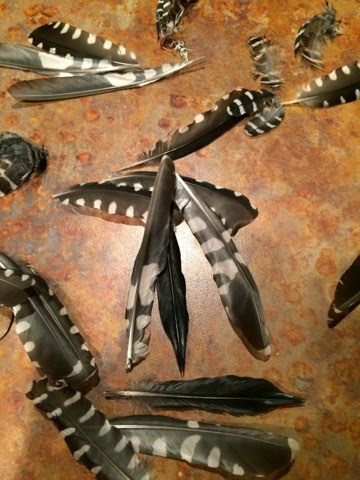
As we were out cactus and bush whacking this morning, my eye was caught by two perfect feathers. This is unusual ... it is rare enough to find one perfect feather, let alone two.

"Kachina feathers!" I called over to Don.

At which point he noticed many more feathers, some bloody ... no body to be seen ... but there was a hole at the base of a nearby tree, a den perhaps, so we gave it a wide berth as we gathered ...


wondering if it was a fox that did the deed ... although I'm beginning to suspect the local stray cat that frequents our neck of the woods.

Anyway, the feathers are now in the freezer ... a strategy suggested by our hosts at Ravens Ridge who claim it kills the mites that otherwise turn feathers into ragged shadows of themselves.

Later in the day, we headed to the Fiber Art Show that I first read about on Grace's Windthread. Underlying Order would have caught my eye had it been there, no question about it.

I asked if photos were allowed ... and was pleased by the affirmative answer.  As we strolled through, Don was taken by a piece that brought Kachinas to mind ...

Note the feathers ...


and by the golden piece behind it ...


the color more faithfully captured in this detail ...


But my eye was caught by this rusted gem ...


which included a fair bit of hand embellishment along with machine stitching ... 


Turns out it was made by a neighbor just down the road ... a kindred spirit, for sure ...


But I've saved the best for last and will let the pictures of Sara Coppedge's Enigma speak for themselves ...


A day well spent, not a minute wasted ...

Tuesday, December 9, 2014

- 'Tis the season continued ...

I spent over five hours in a courtroom yesterday ... part of a 250-member jury pool that was whittled down to 12 brave souls. Kantha saved me from despair and I'm thankful to be home today.

While I was gone, Don sanded down the salmon milk paint on the wooden blocks,
revealing the warm golden base coat and wood grain below ...

And I've completed revisions of My Hippie Grandmother ...

in hopes of providing a bit of levity during bedtime reading for some special little ones who grace our lives ...

Friday, December 5, 2014

- 'Tis the season to be making ...

This is a bit of vinegar rusted cloth that I pulled off recently ...


However, having just read that adding different kinds of tea to vinegar will push rust into different colors, I'm looking forward to more experiments ... with thanks to Lotta Helleburg's blog post that alerted me to Jennifer Coyne Qudeen's rust work.

And while I won't be posting as frequently for the next couple of weeks, I won't been idle ... it's just that showing in process and finished projects might spoil Xmas surprises, although I don't think I'm giving too much away with this sneak peek ...


I'm also looking forward to finding the time to blog about a stitch that developed while working on this gift ...


Last, but not least, while checking out the latest treasures at the Bower Bird, I couldn't resist two $10 finds that asked to come home with me ...


The book is mid-1930s vintage, with amazing plates like this one ...


Felt pads have been placed on the tile so it can serve as a trivet without damaging the dining room table ... meanwhile, the book is occupying the coffee table in the living room while I ponder how best to make use of it.

Saturday, November 29, 2014

- Assemblage doodling: Another impression of New Mexico

Don's already playing around with bits and pieces from yesterday's Junkology field trip ...

Note: the roadrunner is an old adding machine cash register key

He's definitely got New Mexico on his mind ... and I'd better get some rust dyeing done before he bolts everything down!